
Why Business Growth Starts With Leadership Clarity
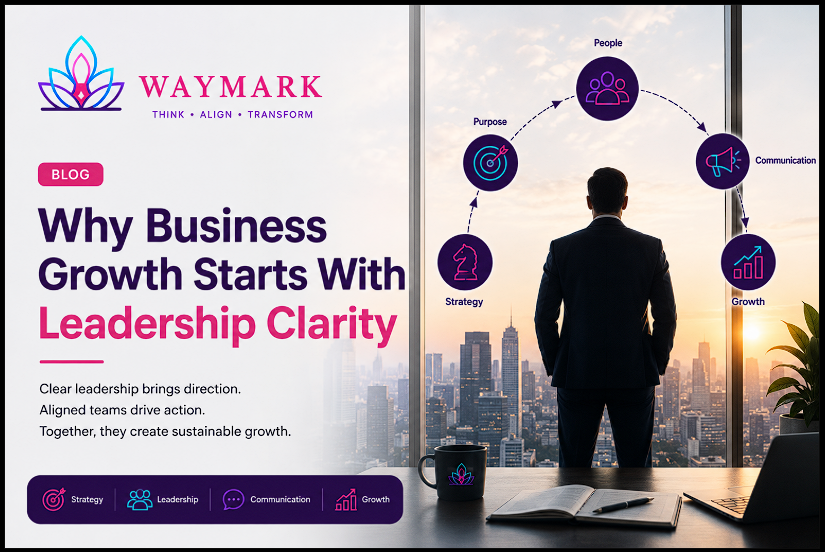
Business growth is not always limited by resources or market opportunities. Often, the real challenge is a lack of leadership clarity. Discover how aligned leadership, strategy, communication, and people can create the foundation for sustainable growth.
Why Business Growth Starts With Leadership Clarity
Business growth is often measured through revenue, customers, market share, and profitability. But behind every sustainable business is something less visible and equally important: leadership clarity.
When leaders are clear about where the organization is going, why it matters, and how the team will get there, decision-making becomes easier, teams become more aligned, and growth becomes more intentional.
On the other hand, when leadership lacks clarity, even capable teams can struggle with competing priorities, communication gaps, slow decisions, and inconsistent execution.
At Waymark LLP, we believe meaningful business growth happens when purpose, strategy, leadership, communication, and people work together.
What Is Leadership Clarity?
Leadership clarity means having a clear understanding of the organization's direction and being able to communicate that direction effectively.
It involves answering fundamental questions:
- Where are we today?
- Where do we want to go?
- Why does that destination matter?
- What should we prioritize?
- What needs to change?
- How will we measure progress?
Without clear answers, businesses can fall into a cycle of reacting to problems instead of proactively building for the future.
Leadership clarity does not mean having every answer. It means having enough direction to make better decisions and helping others understand how their work contributes to the bigger picture.
Why Leadership Clarity Matters for Business Growth
1. It Creates Better Strategic Decisions
Business leaders make decisions every day. Some are operational, while others can influence the company's long-term direction.
When the organization's goals and priorities are clearly defined, leaders can evaluate opportunities based on strategic relevance rather than simply reacting to what appears urgent.
This helps businesses focus their time, resources, and energy on initiatives that genuinely contribute to growth.
2. It Aligns Teams Around a Common Direction
A strategy is only useful when people understand it.
Employees can work hard and still move in different directions if priorities are unclear. Leadership clarity helps translate organizational goals into understandable expectations for teams and individuals.
When people understand both what needs to be achieved and why, collaboration becomes stronger and accountability becomes more meaningful.
3. It Strengthens Leadership During Change
Growth often brings change.
Businesses may enter new markets, restructure teams, adopt new technologies, change their positioning, or move from founder-led operations toward a more structured leadership model.
These transitions can create uncertainty.
Clear leadership provides stability during these periods by giving people a consistent sense of direction while allowing the organization to adapt.
Strategy and Leadership Must Work Together
A common mistake is treating strategy and leadership as separate activities.
A business can have an excellent strategy on paper and still fail to execute it if leaders cannot create alignment across the organization.
Similarly, strong leadership without a clear strategy can result in energy and effort without sufficient direction.
Sustainable growth requires both.
Strategy defines where the organization is going. Leadership helps people move there.
This is why leadership development should not be viewed simply as a training exercise. It should be connected to the actual challenges, decisions, culture, and strategic priorities of the organization.
Communication Is the Bridge
Leadership clarity has little value if it remains inside the leadership team.
Communication is the bridge between strategic intent and organizational action.
Leaders need to communicate priorities consistently across meetings, teams, presentations, internal communications, and stakeholder interactions.
Effective communication should answer three questions:
What are we trying to achieve?
Why does it matter?
What does it mean for me and my team?
When these questions are addressed consistently, organizations can reduce confusion and create stronger alignment.
From Founder-Led to Organization-Led Growth
For many growing businesses, particularly SMEs and family businesses, the founder plays a central role in almost every decision.
This can work during the early stages of a company.
But as the organization grows, excessive dependence on one person can become a constraint.
The business needs systems, capable leaders, clear responsibilities, and decision-making structures that allow the organization to operate effectively without every decision returning to the founder.
This transition requires more than delegation.
It requires leadership development, organizational alignment, and a clear understanding of the business's future direction.
Building a More Sustainable Growth Path
Sustainable growth is not simply about growing faster.
It is about building an organization that can continue to perform as its complexity increases.
That means developing:
- Clear strategic priorities
- Strong leadership capabilities
- Aligned and accountable teams
- Effective communication systems
- A purposeful organizational culture
- Strong market positioning
- Capabilities that can evolve with changing business needs
When these elements work together, growth becomes less dependent on individual effort and more supported by the organization itself.
A Better Question for Business Leaders
Instead of asking only:
"How can we grow faster?"
Business leaders should also ask:
"What needs to become clearer, stronger, or better aligned for us to grow sustainably?"
The answer may involve strategy.
It may involve leadership.
It may involve team capability, communication, organizational culture, or brand positioning.
Often, it is a combination of all of them.
Moving From Pressure to Purposeful Progress
Every business reaches moments where the existing way of working is no longer enough.
Growth may create complexity. Leadership responsibilities may increase. Teams may become misaligned. A brand may no longer reflect the direction of the business.
These moments are not necessarily signs of failure.
They can be opportunities to step back, create clarity, and build a stronger foundation for the next stage.
At Waymark LLP, the approach is centered on helping founders, executives, and organizations move from uncertainty toward purposeful progress through business coaching, leadership development, training, brand strategy, and marketing communication.
The objective is not simply to provide advice.
It is to help leaders build the clarity, capability, and confidence required to move forward.
Final Thoughts
Business growth is ultimately driven by people making decisions and taking action.
When leadership has clarity, strategy becomes easier to communicate, teams become easier to align, and execution becomes more focused.
The strongest organizations do not simply chase growth. They build the leadership, culture, strategy, and capabilities required to sustain it.
Growth begins with clarity. Sustainable growth begins when that clarity becomes shared across the organization.
Learn more about how Waymark LLP helps businesses strengthen strategy, leadership, communication, and sustainable growth through its integrated approach to business coaching, corporate training, and brand strategy.